



Know Your Gear
- Details
- Hits: 2079
We discussed standardizing channels in a previous ARES net (and also at a recent WGARS meeting). Why? Consistency makes for an easier time dealing with unusual circumstances; not having to spend time and mental effort finding the right channel.
Even more important is to understand how to operate the radio. Here are a few items to be sure you know how to do:
Power
Obviously the most important thing to know how to do.
The Display
Do you know what all those little symbols on the display mean? At least the important ones? It's a good
Amateur Radio, ARES, and RACES
- Details
- Hits: 4423
In previous ARES presentations I have made reference to other entities that either provide Emergency Communications services, or need the ability to utilize them during an emergency.
 While we focus on the Amateur Radio Emergency Service (ARES), sponsored by the ARRL, for providing emergency communications, the only entity recognized formally in FCC regulations is the Radio Amateur Civil Emergency Service (RACES). So what is RACES, and why do we hear so little about it?
RACES is recognized in FCC regulations Part 97, Section 407. RACES is a service comprised of Amateur Radio operators who report directly to a Civil Defense Agency like FEMA, GEMA, and local
QRP And Amateur Radio
- Details
- Hits: 2174
While many operators tend to operate using the 100W or 200W their radio provides, and yet others use external amplifiers to run hundreds, even more than 1KW, there are others who operate at the other end of the spectrum, 5-10 Watts.
QRP operation is often practiced by operators participating in Parks On The Air (POTA) or Summits On The Air (SOTA), who are often hiking or backpacking their equipment to the operating location, carrying their power source with them. Naturally, packing a Marine Battery would be a bit of a challenge, so smaller and lighter batteries with lower power capacity are used.
Due to limitations in available power the operators naturally run less power, usually 20W or less. QRP is generally considered 5-10W, but even 20W is possible with more efficient modern equipment and Lithium batteries.
Disaster Preparedness Month 2025
- Details
- Hits: 3709
September is National Preparedness month, and we'll continue our discussion of preparedness. It is fitting we cover the topic as a group, but even more so at home with your family.
Recent discussions have included a variety of people volunteering information about their preparation efforts (or lack of). The most recent West Georgia Amateur Radio Society (WGARS) featured a discussion between Sierra (K4SBE) and John (WD8LQT) regarding her deployments to disaster areas. That discussion focused on catastrophic events where, quite frankly, there is little any of us could do beyond wait for help (i.e. houses destroyed, infrastructure inoperable, etc). Probably the best advice for these types of events, especially if we know they are coming, is to wear a full set of clothes, even when going to sleep - so if something does happen you have some basic personal protection from the elements! We hope to have a video of that discussion available soon.
Third Party Traffic
- Details
- Hits: 2463
When we discuss Amateur Radio and handling traffic, either formal or informal, we tend to think of actual Amateur Radio Operators at the microphone, key, or computer passing information. However, particularly when moving tactical traffic, it may be beneficial to let the third party have the microphone, or type the message into a Winlink email.
Section 97.115 provides for allowing third party traffic as long as the control operator, a licensed Amateur Radio Operator, is in control of the station and monitoring the activity. All requirements that would apply to a typical contact would apply (identifying at proper intervals and at end of communication, use of non-coded communication, avoiding profanity, etc).
Will We Or Won't We (Deploy)?
- Details
- Hits: 4754
During Field Day (2025) a discussion of work being done outfitting the WGARS communications trailer digressed into a debate of whether Amateur Radio operators would ever really be deployed in a local emergency. One operator insisted it would never happen, while another acknowledged the probability was low, but it was not outside the realm of possibility.
The discussion was mostly centered around the fact that post 911/Katrina government communications systems are better integrated, allow various levels of inter-department and inter-agency communications
Deployable Antenna Support Systems
- Details
- Hits: 6340
We've spent a lot of time discussing training for deployment, what personal supplies we'd bring to a deployment, and what radio gear we would bring along, but what to do for antennas?
Yes, roll-up or J-pole antennas have been discussed often for years; to a lesser extent we have discussed low-flying HF (NVIS) antennas. We never know where our deployments may send us, and in many cases trees or other antenna supports may be some distance away, so extra coax and/or rope will be handy in those instances.
NTS and ICS-213 Messages
- Details
- Hits: 16226
Note: Images may be clicked for enlarged view
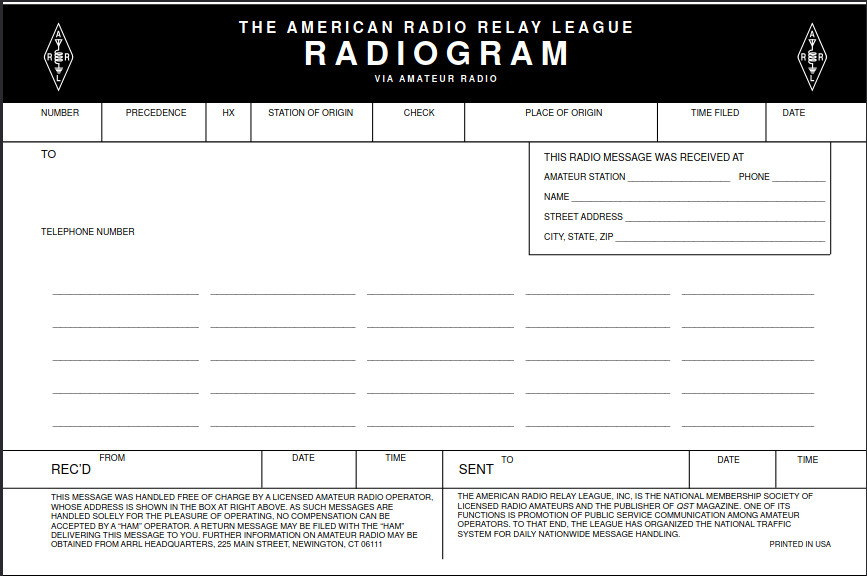 The National Traffic System (NTS) has provided a means of passing messages (usually referred to as traffic) via Radiograms for almost as long as amateur radio has existed. Before long distance telephone was common, and until the
Should You Use UTC Or Local Time?
- Details
- Hits: 5566
The use of "local", Universal Time Coordinated (UTC/Zulu/GMT), or a specific time zone (like Eastern) when specifying the time a message was created or a net is scheduled, or even passing the current time over the net can create confusion for all involved, especially when nets or message traffic cross time zones.
Here, in Carroll County, Georgia, we are close enough to the Central time zone that their and our VHF net times are "one hour off" from each other.
Other Benefits Of Field Day
- Details
- Hits: 4800
We've discussed the usefulness of Field Day as an EMCOMM training exercise as well as a fun weekend event. We've talked about the benefits of having deployment ready equipment, especially antennas and patch cables. The same equipment used on field day can be easily deployed to ad-hoc shelters, hospitals, or other locations. Field Day preparation, setup, and operation allows for testing, debugging, and finally operating equipment, ensuring the equipment is actually functional and ready for use during an emergency.
There are other benefits of Field Day beyond those above, some only marginally applicable to Emergency Communications, but still very useful. These include educational sessions and, in some cases, other activities.
Page 1 of 8