




A powerful magnitude 7.7 earthquake struck off Flores Island in Indonesia's East Nusa Tenggara (NTT) province on August 15, 2026, damaging nearly 12,000 homes, hundreds of schools and health facilities, blocking critical highway supply routes like the Trans Ende-Bajawa road via landslides, and disrupting communications throughout the region.
Indonesia's Emergency Management and Amateur Radio leadership's advanced preparation paid off. Repeaters with backup power systems and the IO-86 (Oscar 86) Satellite enhanced their HF capabilities, heavily leveraging digital modes.
Early in the incident Amateur Radio operators began relaying traffic using Winlink, JS8Call, and DDigi were used to send lengthier communications, short tactical messages, and formal ICS style messages, respectively.
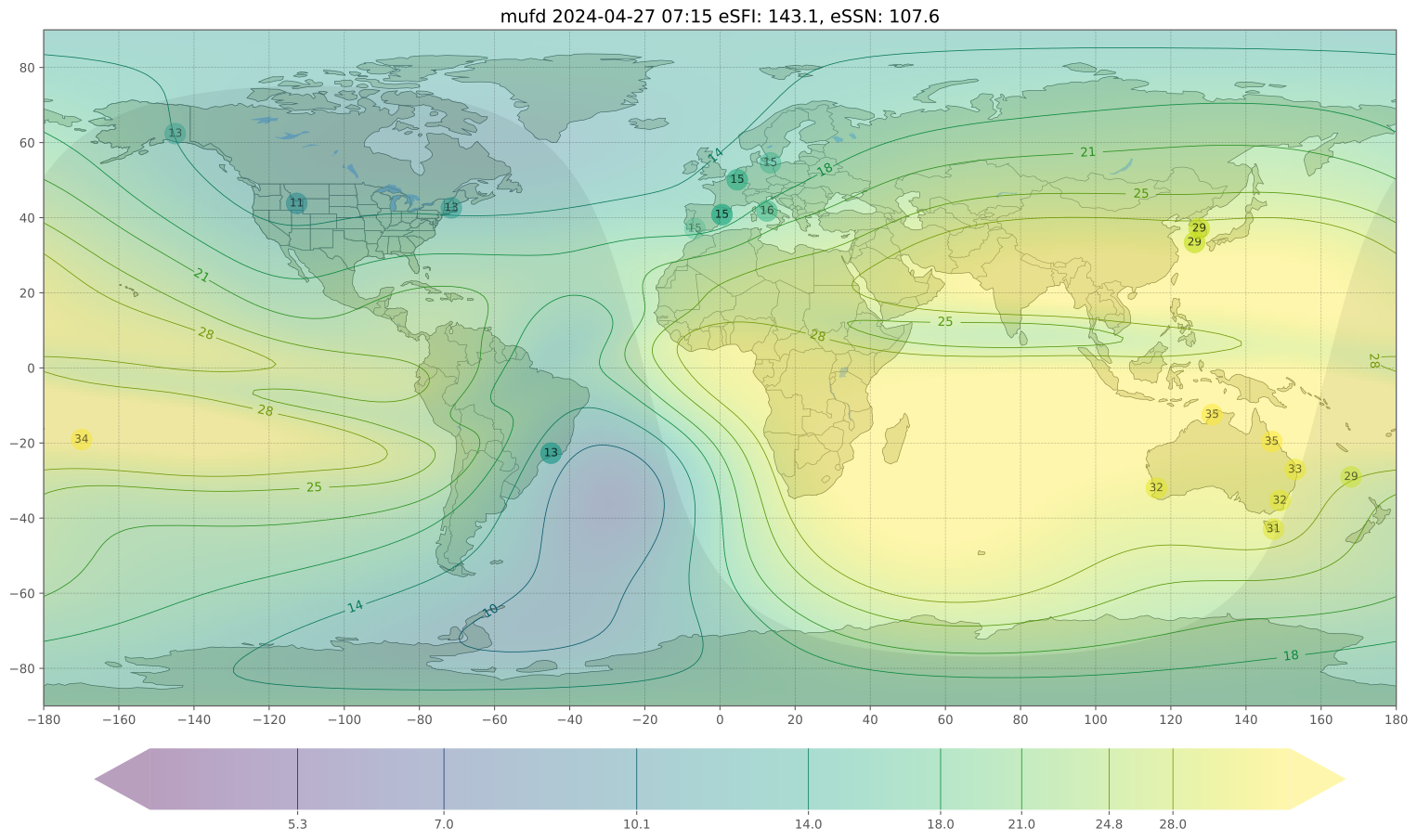
Operators utilized the Winlink Network to send standard email - complete with text and small file attachments—entirely via radio waves. When local internet was down, stations connected via High Frequency (HF) radio to operational Winlink gateways hundreds of miles away in unaffected parts of Indonesia or neighboring countries, which then forwarded the messages to traditional internet email addresses.
JS8, a weak-signal digital mode, allowed operators to send live, keyboard-to-keyboard text messages under extremely poor radio conditions. Because JS8Call can decode signals that are completely buried in background noise, it enabled low-power stations with compromised or temporary antennas to successfully transmit critical text updates.
FlDigi was deployed to send structured, error-free text forms. By pairing FLdigi with Flmsg, operators used standardized emergency templates (such as ICS forms) to ensure that medical needs, logistics requests, and structural damage reports were sent accurately without typing errors.
Indonesian operators went one step further proving this isn't you grandfather's radio hobby anymore. The IO-86 amateur radio satellite (officially known as LAPAN-A2 or LAPAN-ORARI) was activated by Indonesia’s national amateur radio society, ORARI, as a critical spaceborne communications bridge during the August 2026 earthquake response.
Because the earthquake disrupted ground-based towers and isolated remote mountain hamlets, operators used the satellite to relay data directly over the disaster zones. The satellite was utilized in two primary ways, tactical voice via the satelite's cross-band repeater and the onboard APRS repeater for short text messaging and position reporting.
Standard line-of-sight VHF/UHF Handheld Transceivers cannot communicate across mountains. However, when IO-86 passed overhead, its FM cross-band transponder (uplink: 145.880 MHz / downlink: 435.880 MHz) acted as a flying radio repeater. Low power (5W) radios with Arrow or other Yagi antennas allowed scheduled tactical communications.
IO-86 carries an Automatic Packet Reporting System (APRS) digipeater operating under the tactical callsign YB0X-1. This payload acted as a digital relay in space, not just allowing tactical text traffic, but also update tactical team locations.
Unlike most polar-orbiting amateur satellites that only pass over a specific region twice a day, IO-86 flies in a specialized low-inclination equatorial orbit. This allowed the satellite to pass over the Indonesian archipelago roughly 14 times a day. This high-frequency pass schedule provided disaster response teams with predictable, recurring windows of satellite coverage every few hours to send and receive life-saving reports when traditional networks were completely dead.